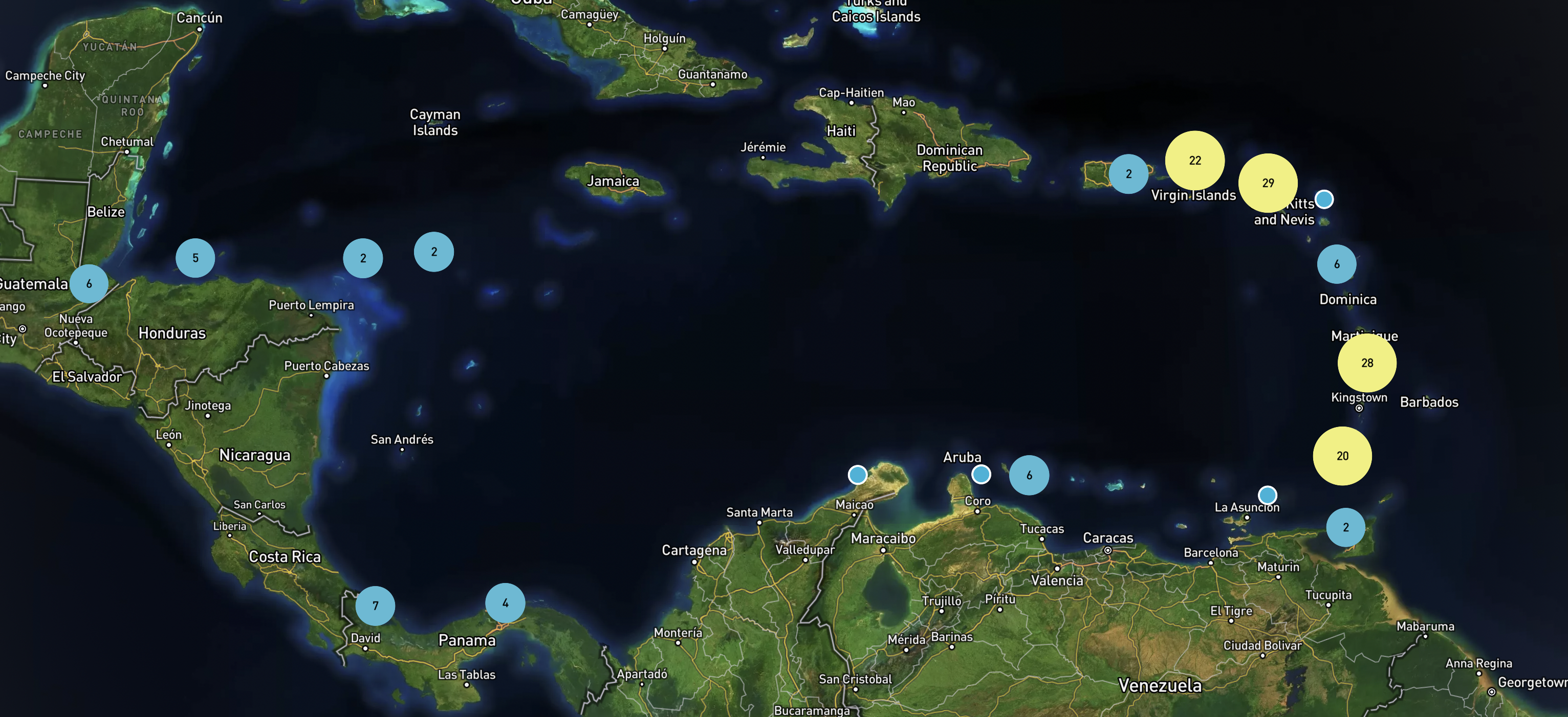

REPORTED YACHT CRIME – CARIBBEAN REGION
In 2024, reported incidents of crimes against yachts reached an all-time high of 145 - up 41 % from 103 in 2023. The surge was driven almost entirely by non-violent offenses, which rose 57 % (137 vs. 87). Violent incidents, by contrast, fell 50 % to 8, their first decline in recent years.
A steady climb through most of the year, capped by a record spike in December, produced the new annual total. The CSSN Annual Report 2024 analyses those trends and highlights an encouraging turn away from the violence of prior years, while pinpointing both familiar and emerging hotspots.
CSSN continues to deliver indispensable risk-planning information to our community. First-hand, volunteer-vetted reports form the backbone of our centralized, publicly accessible database, providing cruisers with timely, accurate information about how and where they cruise. Enhancements rolled out this year - including new analytical tools on the CSSN website - are showcased in the following pages. The charts and graphs are now interactive and can be toggled to customize. The country links will also take you to an interactive map where you can explore reported incidents in more detail.
The Leeward Islands were notably active in 2024. The British Virgin Islands (BVI) emerged as the single most active country, with 20 reported incidents—half of them at the small but popular island of Jost Van Dyke. Historically, the BVI have seen few or no incidents, but a mix of charter boats and complacent cruising yachts presented many easy targets for well-prepared thieves. Tracking devices, when present, were frequently found and then routinely disabled. Saint Martin/Sint Maarten was also very active, with 12 and 13 reports, respectively—representing year-over-year increases of 110 % and 300 % compared to 2023. Most of the activity occurred in the shared Simpson Bay Lagoon, which accounted for 20 total reports.
In Central America, activity rose modestly compared to 2023. Panama recorded 11 incidents. Honduras had 9 reports, divided between offshore piracy-related suspicious activity and thefts in Roatan. Guatemala's Río Dulce contributed 6 reports to regional totals.
The Windward Islands together accounted for 50 reported incidents, roughly 30 % of all regional activity. Grenada led the group with 17 reports—a 150 % year-over-year increase—distributed across many anchorages, and included a violent report that claimed the lives of two cruisers. Martinique had 13 incidents, a 110 % increase, concentrated in its most popular anchorages. St. Lucia followed with 11 reports, mainly from Rodney Bay, representing a 140 % increase. In contrast, St. Vincent and the Grenadines reported 7 incidents, a 36 % decrease, likely reflecting reduced yacht traffic following Hurricane Beryl's impact on several key islands and ongoing recovery challenges in this multi-island country.
Incident reports also demonstrated some seasonal patterns, with December experiencing a dramatic surge to 31 reports—a historic high. April showed a secondary peak of 20 incidents, while the traditional hurricane-season months of August and September saw significantly reduced activity.
Visit the CSSN website to explore, filter, and expand the interactive incident map.
In 2024, reported incidents climbed to 145, the highest point in the five-year trend and a sharp recovery from the pandemic-era low of 72 in 2020, when global travel restrictions severely curtailed cruising activity and limited the movements of not only cruisers, but also those with criminal intent. The rebound followed a clear trajectory: 102 incidents in 2021, 123 in 2022, a brief dip to 103 in 2023, and then a surge to an all-time high of 145 in 2024. This 41% year-over-year increase places 2024 well above the five-year average of 109 incidents.
The monthly distribution reveals some seasonal fluctuations throughout the year. Early months demonstrated activity levels consistent with typical seasonal cruising patterns, with reported incidents generally dispersed across the region. Mid-year months (May through July) had stable incident counts ranging between 9 and 12 reports. August and September represented the year's quietest period with only 5 and 3 incidents respectively, correlating with reduced cruising activity during hurricane season. Autumn months showed gradual increases, culminating in December's unprecedented spike, driven by concurrent surges of activity in the British Virgin Islands and Saint Martin/Sint Maarten.
Theft dominated incident reports across all months, accounting for 72.4% of all incidents (105 of 145). When combined with attempted theft, theft-related crimes represented 83.4% of the total annual reports. Burglary incidents (11 total) occurred across multiple months but showed concentration in December, particularly in Sint Maarten and Panama.
Violent crimes—including assault, piracy, and robbery—remained relatively rare and geographically dispersed throughout the year. Venezuela was the only location where theft was not reported; however, the country recorded 2 violent offshore incidents involving piracy and assault.
While country-level data reveals broad patterns, specific anchorages tell a more granular story. Simpson Bay Lagoon, shared by French St. Martin and Dutch Sint Maarten, emerged as 2024's single highest-risk anchorage with 20 reported incidents—nearly 14% of the regional total. Thieves exploited cross-jurisdictional enforcement challenges, and coordination of resources proved difficult.
Dinghy and outboard theft continue to account for the majority of all successful thefts, occurring most often when dinghies are poorly secured or not secured at all. The consistent use of robust physical security measures—heavy-duty cable locks, heavy-gauge stainless chain, and importantly, lifting and locking dinghies overnight—demonstrably reduces risk. Securing companionways/doorways and hatches overnight provides additional protection.
Unoccupied yachts at anchor for extended periods present attractive targets for burglars. Loud intrusion alarms, surveillance systems, and regular patrols, combined with vigilant neighbors, remain the most effective deterrents.
The dedicated CSSN team remains focused on supporting the cruising community by providing the essential infrastructure for incident reporting, data consolidation, archiving, and dissemination. We continue to make this data freely available in multiple, customizable formats.
CSSN remains an all-volunteer, independent, self-funded team. Safety and security are a shared responsibility. We commit considerable amounts of our time, and it takes only a small amount of yours to keep everyone well and fully informed. If you are a victim, it's easy and important to make a timely CSSN incident report.
We sincerely thank everyone who filed reports and those who supported them. We also appreciate our valued information‑sharing partners—Noonsite, Noforeignland, the Seven Seas Cruising Association (SSCA), and Boatwatch—each of which supports and complements our important mission. Finally, we are grateful to the talented, dedicated volunteers who make all of this possible.
Encourage your friends to subscribe to free CSSN Alerts, join our Telegram channel, enable third-party CSSN data in the Noforeignland app, or follow us on social media. Explore the many new and helpful resources available on our website and make CSSN a permanent part of your risk assessment and cruise planning process.
With your valued input CSSN informs, and captains decide.
KNOW BEFORE YOU GO!
We always welcome your feedback and suggestions, simply click the Contact Us link on any page of the CSSN website.
Safe Cruising,
Kim White and the all-volunteer CSSN team